
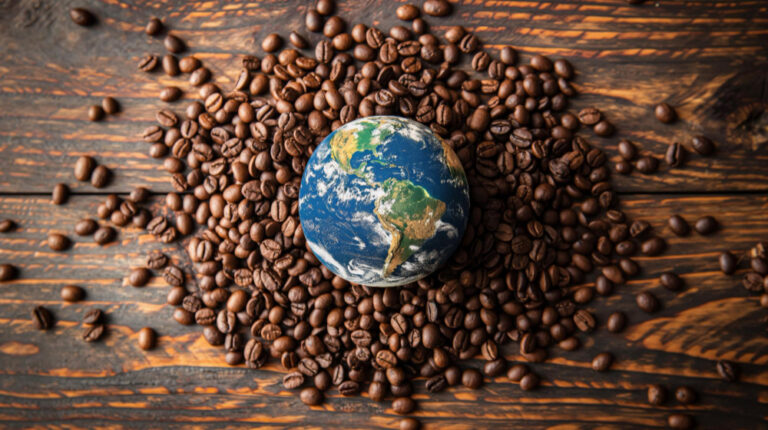
Every cup of coffee you drink this morning was picked by hand. Somewhere in Ethiopia, Colombia, Vietnam, or Guatemala, a smallholder farmer earned less than $1 for the pound of beans that made it. And yet that same pound retails on your supermarket shelf for $12 to $25. This is the paradox at the heart of coffee’s role in local economies — and in 2026, the pressure to resolve it has never been greater.
Coffee is the world’s second most traded commodity after oil. It directly employs over 125 million people worldwide, the vast majority of them smallholder farmers in the Global South who produce 80% of the global crop. The global coffee market was valued at $256.29 billion in 2025, growing at a CAGR of 4.52% toward 2034. This is not a niche agricultural sector. It is a pillar of the global economy — and in 2026, a pivotal moment of reckoning between the value of coffee at origin and the price paid for it on arrival.
The Scale of Coffee’s Economic Footprint in 2026
The numbers tell a compelling story. In the United States alone, coffee represents 1.3% of the entire economy, generating $343.2 billion in economic activity, nearly $38 billion in federal, state, and local tax revenues, and sustaining 2.2 million jobs generating over $100 billion annually in wages. The coffee economy is not peripheral — it is structural.
At the producing end, the picture is equally striking — though not always equitable. Ethiopia, the birthplace of coffee, generated a record $2.65 billion in coffee export revenue in fiscal year 2024/25, exporting nearly 469,000 tonnes. In the first half of fiscal year 2025/26 alone, the country has already earned $1.35 billion, already surpassing its entire FY 2022/23 total in six months. The Ethiopian government has set a $3.0 billion coffee export target for the full 2025/26 fiscal year — a target the current trajectory suggests is achievable.
In Colombia, the coffee sector anchors the livelihoods of millions of rural families. More than 76% of Colombian coffee farmers operate within family-based economies, with the National Federation of Coffee Growers (FNC) serving as the world’s most organised producer institution. The country’s 2025/26 harvest update confirms over 19,525 verified growers engaged in responsible sourcing programs with global buyers, signalling a meaningful shift toward traceability and direct relationships.

The Income Gap: The Unsolved Equation
Despite the sector’s global scale, the income distributed to farmers remains deeply inequitable. In 2026, the raw statistics are stark:
Coffee farmers typically earn only 7–10% of the retail shelf price of the coffee they grow
A typical farmer earns less than $1 per pound of coffee grown, while the same pound sells for $12–25 in consuming markets
In Uganda, coffee farmers earn just $88 per year from coffee — below any reasonable living income threshold
Brazil is currently the only major coffee-growing country where coffee farming income comes close to a living income — and only barely
The Fairtrade model attempts to address this structural gap. In 2023, Fairtrade coffee producers collectively earned €82 million in Premium — money directed toward community investment, agricultural improvements, and social infrastructure. Research from Mainlevel Consulting confirms that farmers within strong Fairtrade cooperatives — those offering training, credit access, and market connections — show greater financial resilience and, in some cases, higher net revenues than non-certified peers. Fairtrade is currently revising its minimum coffee price floor, with a decision expected in 2026.
The IDH Sustainable Trade Initiative frames the core challenge clearly: “Our goal is a world in which all coffee farming households earn at least a living income, where risk and value are distributed fairly throughout the supply chain.” That goal remains far from achieved — but the institutional pressure to reach it is real.
Sustainable Coffee Farming: A Proven Economic Lever
The evidence that sustainable farming practices directly improve farmer incomes is now well-established. Vietnam’s Central Highlands — home to over 25,000 hectares of coffee production in Ea H’leo district alone — provides one of the clearest 2026 case studies. Smart coffee farming programs launched since 2014 have delivered measurable results:
10–30% savings on irrigation water
5–20% reduction in fertilizer use
10–30% lower pest control costs
5–15% yield increase
5–15% profit increase compared to non-participating farmers
These are not marginal gains. At the scale of millions of smallholders, this translates to a transformative economic shift in rural communities. The program’s designers frame it explicitly as the “Green Revolution in the coffee industry” — a label that now has the data to support it.
In Colombia, the cooperative Caficauca offers an equally compelling social dimension: with support from Mercy Corps and the Howard G. Buffett Foundation, the co-op has enabled farmers in conflict-affected regions to replace coca cultivation with coffee — providing training, quality guidance, and processing equipment. This is coffee culture as peace-building economics, not simply agricultural development.

The Climate Crisis: The Industry’s Defining Threat by 2030
No analysis of coffee economics in 2026 is complete without addressing the climate emergency reshaping production geography. The data is alarming: climate change could reduce global Arabica production by 45.2% and Robusta production by 23.5% if current warming trajectories continue. For an industry that depends on stable temperature ranges and predictable rainfall at specific altitudes, this is an existential threat.
The response is already underway. Three adaptation strategies are dominating the 2026 conversation:
Agroforestry and shade cultivation — returning to traditional shade-grown methods to buffer temperature extremes, restore biodiversity, and create additional income streams from timber and fruit
Climate-resilient hybrid varieties — developed through hybridization with wild African coffee species, bred for heat tolerance and disease resistance without sacrificing cup quality
Precision agriculture technology — drones for canopy monitoring, AI-assisted irrigation scheduling, and sensor-based soil management to maximise yields on reduced viable land
Ethiopia’s production forecast for 2025/26 of 11.56 million 60-kg bags — a 9% year-on-year increase — reflects both favourable weather and active investment in improved varieties and productivity programmes. The sector is adapting, but the race between adaptation speed and climate acceleration remains far from won.
The Regulatory Pressure: EU Deforestation Law and Supply Chain Transparency
A new structural force entered the coffee economy in 2025/26: the EU Deforestation Regulation (EUDR), which requires that all coffee imported into the European Union be verified as deforestation-free, with GPS-level traceability to the plot of origin. For Colombia — where 76% of producers are family-scale farmers, many with unclear land tenure — this creates enormous compliance complexity.
The FNC is well-positioned relative to most producers: its cooperative infrastructure, data systems, and long-standing relationships with EU buyers give Colombian farmers a realistic path to compliance. But as one senior FNC official noted directly to Mongabay in 2026: “The EU has to act realistically. You cannot expect a nomadic coffee picker in a coffee-producing country to have the same working conditions as a European farmworker.” The regulation’s implementation timeline and enforcement approach will profoundly reshape which origins thrive and which lose access to Europe’s 450 million consumers.
Blockchain-based supply chain verification, direct trade platforms, and digital traceability tools are emerging as practical responses — enabling buyers to verify claims at origin, and giving farmers certified access to premium markets that reward verified sustainability.
From Farm to Cup: The Full Value Chain Multiplier
One of the most important economic insights about coffee is that the value chain multiplier effect extends far beyond the farm. The entire ecosystem — washing stations, exporters, freight logistics, roasters, café retailers, equipment manufacturers, and digital platforms — creates employment across every economic level.
In developing coffee economies, the shift from raw green bean export toward domestic processing and specialty roasting is a deliberate economic strategy. Ethiopia’s focus on specialty beans — which command a premium of 30–70% over commodity grades — and its infrastructure investment in washing stations and controlled fermentation facilities reflect a national strategy of capturing more value at origin rather than exporting it in unprocessed form. Ethiopia’s 47% revenue increase in the first quarter of FY 2025/26, despite exporting only 75% of its planned volume, illustrates the power of this quality-first approach.
What Responsible Coffee Consumption Means in 2026
For consumers in Europe, North America, and the growing middle-class markets of Asia, the choices made at the point of purchase have direct consequences for farming communities thousands of kilometres away. The 2026 consumer playbook for responsible coffee includes:
Choosing certified coffee (Fair Trade, Rainforest Alliance, UTZ, Organic) — not as a guarantee of perfection, but as a meaningful signal that structural safeguards exist in the supply chain
Supporting direct trade roasters who publish sourcing information, visit origin partners, and pay above market floor prices
Reducing capsule waste through reusable or compostable formats — an environmental choice that also reduces the cost burden on single-use supply chains
Understanding price signals — the cheapest coffee on the shelf almost certainly reflects unsustainable extraction of value from producers at origin

The global coffee market is growing. The question that defines the next decade is not whether demand will sustain — it will. The question is whether that growth will finally translate into living incomes for the 125 million people who make it possible.
The Road to 2030: Regeneration, Not Just Sustainability
The language in the coffee industry has shifted in 2026 — from “sustainable” to “regenerative.” This is not marketing semantics. IDH and major specialty roasters are now investing in models that go beyond maintaining the status quo to actively rebuilding soil health, restoring biodiversity, and strengthening farmer income resilience through integrated farm diversification. The vision is a coffee supply chain where every household in the production chain earns a living wage, every farm contributes to ecological restoration, and every cup carries verifiable proof of that chain.
The global coffee machine market’s trajectory toward $25 billion by 2036 will only be sustainable — in every sense of the word — if the farms at the base of that supply chain are thriving. In 2026, the economic case for regenerative coffee has become as clear as the ethical one.