

The coffee world doesn’t stand still — and in 2026, it’s moving faster than ever. The World Barista Championship is heading to Panama for the first time in its history. AI-assisted brewing systems are landing in home kitchens. “Fine Robusta” is entering premium espresso menus. Functional coffee with adaptogens and protein foams is rewriting the drinks menu. And the very definition of what makes a great barista has fundamentally shifted — from technical executor to sensory scientist and storyteller. Whether you work behind a café bar or pull shots at home every morning, here’s exactly what’s changed in 2026 — and the mistakes that are quietly ruining your cup right now.
What the 2026 World Barista Championship Is Changing
The 2026 World Barista Championship (WBC) is being held in Panama City — the first time in WBC history it takes place in a coffee-producing country in Central America. This location choice is deliberate and symbolic: it signals the SCA’s commitment to elevating producer nations and closing the gap between the farm and the barista. Competing alongside the WBC is the Julius Meinl Barista Cup 2026, running from April onwards, which challenges baristas across three categories: Espresso, Cappuccino, and Signature Drink. Building on the 2024 rule revisions, the 2026 WBC judging framework continues to emphasize sensory specificity and tactile descriptors — thickness, texture, aromatic complexity — over pure technical execution. The message to every working barista is the same: being able to pull a technically correct shot is the baseline. Describing precisely why it tastes the way it does is the new competitive frontier.
“This is the first time the WBC will be hosted in Central America, and marks the long-awaited return of the world stage to a coffee-producing country — a powerful statement about where specialty coffee’s future lies.” — WBC Official, World of Coffee Panama 2026
The 5 Biggest Barista & Brewing Trends of 2026
🎯 1. Consistency Over Complexity — Data-Driven Brewing
The defining philosophy of 2026 specialty coffee is consistency over complexity. After years of experimental recipes, unusual fermentation profiles, and theatrical presentation, cafés are refocusing on what actually matters to most customers: a cup that tastes exactly the same across every shift, every barista, and every hour of the day. Data-led brewing — tracking dose, yield, grind size, temperature, and flow rate as measurable parameters rather than “feel-based” intuition — is now the professional standard. Smart grinders that monitor grind consistency in real time and app-connected espresso machines that store extraction data per shot are becoming standard equipment in forward-thinking specialty cafés. As LinkedIn’s 2026 brewing trends report summarizes: “In 2026, brewing success will be measured less by experimentation and more by how reliably a cup can be reproduced during peak hours.”
🤖 2. AI-Assisted Brewing Enters the Mainstream
2026 marks the year that AI-powered brewing systems cross from commercial novelty to accessible reality. At the professional level, machines like the Schaerer Soul 2-Step automatically steam milk externally to precise temperatures and textures — hands-free, shift after shift — allowing baristas to focus entirely on service and latte art. At the home level, app-connected super-automatics from Jura (J.O.E.®), Bosch (Home Connect), and emerging AI brewing calculators are learning user taste preferences and adjusting grind, temperature, and extraction parameters automatically. Even smart grinders capable of real-time particle consistency monitoring are now available for home use. The barista’s role is not being replaced — it’s being freed from repetitive calibration tasks to focus on the things that genuinely require human judgment: sensory evaluation, hospitality, and creativity.
🍄 3. Functional Coffee — The New Drinks Menu
The single fastest-growing trend in 2026 specialty coffee is functional brews — coffee enhanced with health-active ingredients served as genuine café menu items. Lion’s Mane and Reishi mushroom adaptogen shots, protein-infused foam toppers, collagen cold brews, ashwagandha lattes, and L-theanine espresso blends are moving from health food stores to mainstream coffee bar menus. For baristas, this creates an entirely new preparation skill set: understanding which additions interact with espresso extraction chemistry, how to steam and texture non-dairy functional milks, and how to present these drinks in a way that communicates both their flavor profile and their functional benefit. Customers in 2026 want their coffee to do something for them — not just wake them up.
⚗️ 4. Fermentation-Forward Coffees — Still Growing
Carbonic maceration, anaerobic fermentation, double-fermentation washed processing, and specific-yeast inoculation are no longer competition-only curiosities — they are mainstream menu staples in specialty cafés in 2026. Climpson & Sons’ 2026 trend report confirms: “Fermentation-forward coffees look set to stay — driven by both consumer demand for novelty and producers seeking to diversify and mitigate climate risks.” For baristas, these highly processed coffees demand adjusted extraction parameters: their elevated acidity, concentrated fruit compounds, and complex sugar profiles respond differently to temperature and yield than traditionally washed or natural-processed beans. A barista who treats a carbonic maceration Kenyan the same as a classic Colombian washed will extract very different results.
❄️ 5. Precision Cold Coffee — Beyond the Basic Iced Latte
The cold coffee evolution that began in 2022 reaches maturity in 2026. Nitrogen-infused cold brew, flash-chilled espresso, and precision cold brewing methods that lock in volatile aromatics without ice dilution are now expected offerings at any serious specialty café. Java City’s 2026 coffee trends report describes the shift: “The trend is moving toward precision-chilled beverages that prioritize flavor integrity over simple convenience.” The technique emphasis for baristas is flash-chilling rather than ice-diluting: concentrating the espresso slightly, then cooling it rapidly over a copper cooling coil or frozen stone surface before serving — preserving aromatic compounds that dissolve immediately when hot espresso hits standard ice.
The 2026 “Golden Variables” — Master These or Nothing Else Matters
In 2026, the industry has unified around a framework called the Golden Variables of Extraction — four parameters that every barista, professional or home, must control with precision before anything else:
| Variable | What It Is | 2026 Pro Standard |
|---|---|---|
| ☕ Dose | The weight of dry coffee grounds before extraction | 18–20g for double espresso — measured to 0.1g every shot |
| ⚖️ Yield | The weight of liquid espresso in the cup after extraction | Target brew ratio: 1:2 (18g in : 36g out) — scale mandatory |
| ⏱️ Time | Total extraction duration from pump engagement to stop | 25–35 seconds for standard espresso — adjusted per bean |
| 🌡️ Temperature | Water temperature at group head during extraction | 90.5°C–96°C — adjusted lower for light roasts, higher for dark |
Barista Mistakes You’re Still Making in 2026
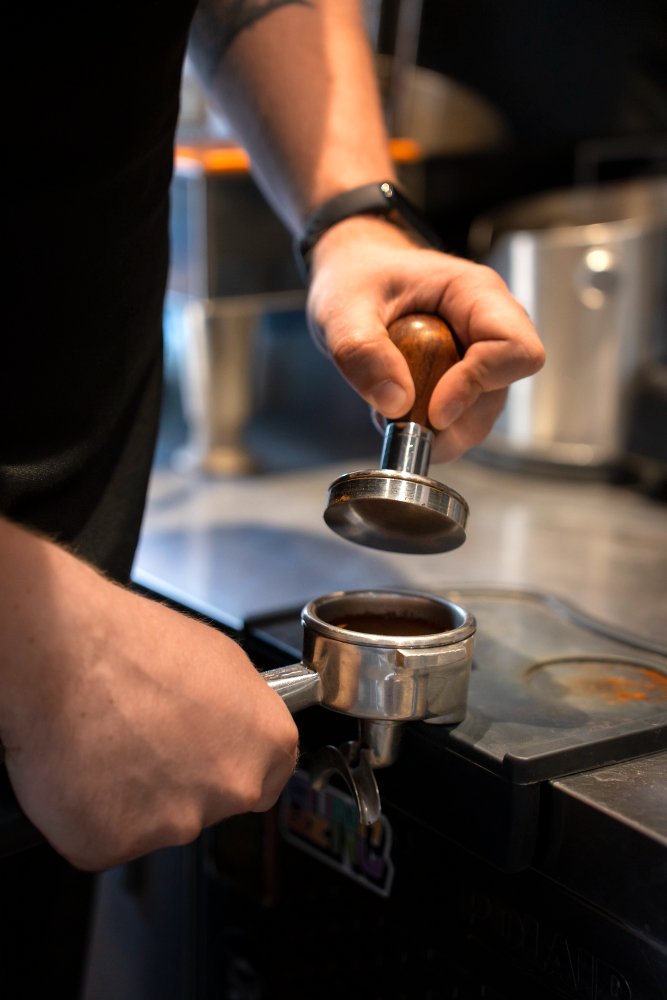
❌ Mistake 1: Tapping the Portafilter After Tamping
Still the most widespread bad habit behind the bar in 2026 — and still one of the most damaging. After tamping, tapping the side of the portafilter to knock off loose grounds cracks the puck, creating channels where water bypasses the coffee during extraction, producing a bitter, unbalanced shot. The tamped puck must remain a sealed, continuous disc. Fix: use a WDT (Weiss Distribution Technique) tool or finger-wipe to remove loose grounds from the basket rim before tamping — never after.
❌ Mistake 2: Skipping the Group Head Purge
The group head retains residual water between shots — water sitting at elevated temperature, absorbing stale oils from the shower screen. A 2-second purge before locking in your portafilter clears stale water, cleans the screen, and stabilizes brewing temperature. In 2026, with precision temperature profiling becoming standard, starting a shot without a purge is the equivalent of deliberately introducing a temperature variable you didn’t choose. Cost: zero. Impact: measurable and consistent.
❌ Mistake 3: Brewing Without a Yield Scale
Eyeballing espresso yield or relying on time alone is no longer acceptable at any serious level of coffee preparation. A 1–2g variation in output changes extraction balance significantly. In 2026, professional standards require a 0.1g-precision scale under every cup, with target brew ratio noted per bean. For home users, this is still the single most impactful $20–$30 upgrade available — more impactful than most $200 machine upgrades. If you’re not weighing your yield, you’re not brewing consistently. You’re guessing.
❌ Mistake 4: Ignoring Water Chemistry
In 2026, water chemistry has moved from specialist obsession to standard barista knowledge. Tap water mineral content directly affects extraction: too soft = flat, under-extracted coffee; too hard = over-extraction, scale buildup, and masked flavors. Magnesium in water specifically enhances coffee flavor extraction — it’s why Third Wave Water and similar mineral-packet systems gained widespread professional adoption. Testing your water’s TDS (Total Dissolved Solids) — ideally 75–175 mg/L for espresso — takes 30 seconds with a $15 TDS meter and can explain flavor inconsistencies you’ve been blaming on your grinder for years.
❌ Mistake 5: Reheating Steamed Milk
Leftover milk reheated for the next drink has already had its proteins denatured and sugars caramelized — adding it to fresh cold milk and resteaming produces degraded, gritty foam that no pouring technique can rescue. In 2026 with plant-based milks now mainstream on café menus — oat, macadamia, pea protein — this mistake is even more damaging: alternative milks are more sensitive to over-heating and repeated temperature cycling than dairy. Rule: always start with fresh, cold milk in a clean, rinsed pitcher. Always.
❌ Mistake 6: Not Adapting to Fermented & Processed Beans
This is the 2026-specific mistake that even experienced baristas are making. Anaerobic, carbonic maceration, and double-fermented coffees require different extraction parameters than conventionally processed beans. Their elevated acidity, concentrated fruit esters, and modified sugar structures respond to temperature and yield differently. Treating a natural-processed Ethiopian the same as a washed Colombian will produce very different results — often over-extracted bitterness from the fermented bean’s more soluble compounds. In 2026, dialing in means understanding processing method, not just origin.
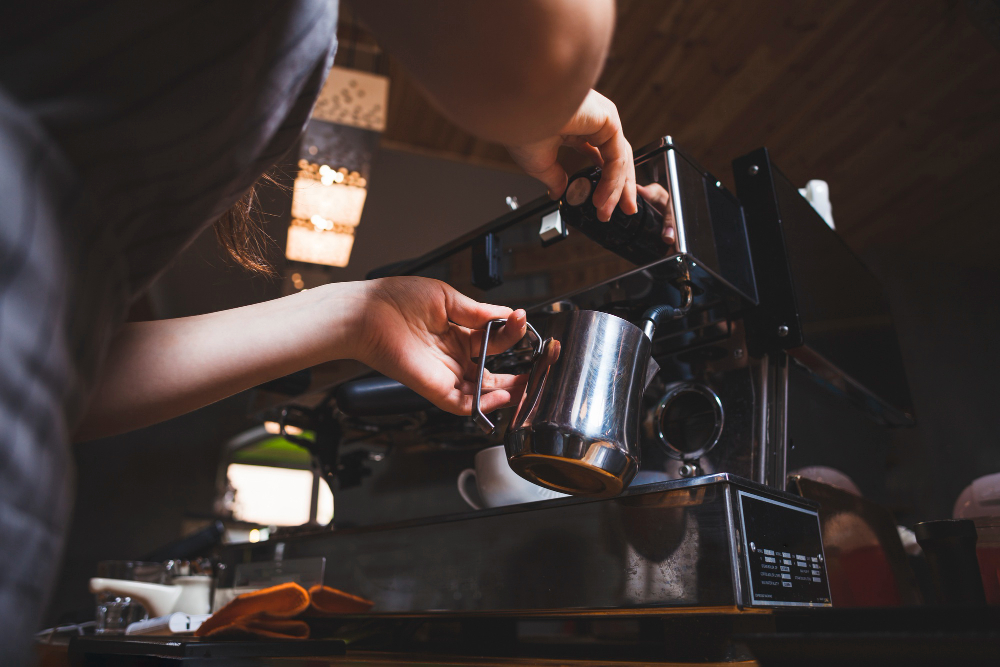
❌ Mistake 7: Underestimating the Steam Wand
Milk texturing for 2026’s expanded drink menu — from classic cappuccinos to oat-milk functional lattes to protein foam toppers — demands more steam wand precision than ever. The wand tip should sit just below the milk surface at a slight angle to create a consistent rolling motion. The “paper-tearing” air incorporation phase should last no more than 1–2 seconds before the wand submerges for texturing. After every use: purge 1 second, wipe immediately — no exceptions. Leaving any milk residue on the wand for even 30 seconds allows it to bake on and eventually block the steam holes.
2026 Barista Technique Cheat Sheet
| Technique | ✅ 2026 Best Practice | ❌ What to Stop Doing |
|---|---|---|
| Coffee Distribution | WDT tool or vibration distributor for even vertical settling | Dropping dose into basket without redistribution |
| Tamping | Level, consistent pressure — no tap afterward | Tapping portafilter post-tamp — cracks the puck |
| Yield | Scale to 0.1g — target brew ratio (e.g. 1:2) | Eyeballing or time-only extraction |
| Group Head | 2-second purge before every shot | Skipping the purge — stale water ruins the first taste |
| Milk | Fresh cold milk, wand just below surface, circular motion | Reheating leftover milk from previous drinks |
| Steam Wand | Purge + wipe immediately after every use | Leaving residue — causes biofilm and blocked holes |
| Water | Test TDS (75–175 mg/L ideal for espresso) | Using tap water without checking mineral content |
| Fermented Beans | Adjust temperature and yield per processing method | Using same recipe for all beans regardless of process |
| Temperature | 90.5°C–96°C, adjusted per roast level and origin | Fixed temperature regardless of bean type |
| Functional Additions | Test interaction of adaptogens/proteins with your espresso recipe | Adding functional ingredients without adjusting recipe |
The 2026 Barista Standard
In 2026, the best baristas are not those who master a fixed set of techniques — they’re those who understand why each variable matters, and can adapt intelligently when the beans, the water, the milk, or the menu changes. AI handles consistency. Machines handle calibration. What remains irreplaceable is the human judgment to taste, adjust, describe, and create. That’s what separates a button-pusher from a true barista in 2026 — and what always will.