Grind size is the single most powerful variable in your cup. Master these 10 principles and unlock the full potential of every bean you buy.
Ground coffee loses 50% of its aromas in just 15 minutes due to oxidation. Never buy pre-ground. Grind only the dose you need, right before brewing — even the world's finest beans will disappoint if ground in advance.
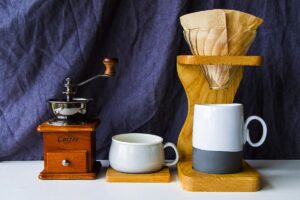
Blade grinders chop beans unevenly, producing a cup that is both bitter and sour. Burr grinders (flat or conical) crush beans uniformly for consistent, balanced extraction.
Starter picks: Timemore C2 (~$55) · 1Zpresso JX (~$99)
Particle size directly controls how fast water extracts flavors. This is the most important and most misunderstood principle in home brewing.
| Method | Grind Size | Brew Time |
|---|
| Espresso | Extra fine (powdered sugar) | 25–30 sec |
| V60 / Pour-over | Medium-fine (fine sand) | 3–4 min |
| Drip Filter | Medium | 4–6 min |
| French Press | Coarse (coarse salt) | 4–5 min |
| Cold Brew | Extra coarse | 12–24 h |
Without a scale, your dose varies invisibly each session — making improvement impossible. The 2026 pro standard: a 0.1 g precision scale.
- Espresso: 1:2 ratio (18 g coffee → 36 g in cup)
- Filter: 1 g coffee per 15–17 g water
When your cup is off, instinct says "add or remove coffee." That's almost always wrong. Adjust grind size first, one notch at a time.
- Bitter / harsh → too fine → open one notch coarser
- Sour / flat / watery → too coarse → close one notch finer
Dark-roasted beans are more porous and extract faster — grind slightly coarser. Dense specialty beans (Ethiopian natural, Kenyan washed) may need a finer grind. Many roasters now print a recommended setting on the bag.
Coffee absorbs moisture from the air, changing how it grinds. On humid days: open slightly coarser. On dry days: close slightly finer. A small adjustment goes a long way.
Grinders always retain some old coffee (retention). Stale particles contaminate your fresh dose. Grind and discard 1–2 g before your real dose — especially after a setting change or period of non-use.
Coffee oils accumulate on the burrs, go rancid, and taint every cup.
- Weekly — brush the grinding chamber
- Every 2–4 weeks — deep clean with Grindz tablets
- Tip — a few raw rice grains absorb residual oils
- Never — rinse burrs with water (unless manufacturer-approved)
Pros don't guess — they document. Note grinder setting, dose, method, water temperature, and taste each session. This turns random trial-and-error into a repeatable, improving process. Apps like Brewlog or Roast.World help track how settings shift as beans degas after roasting.